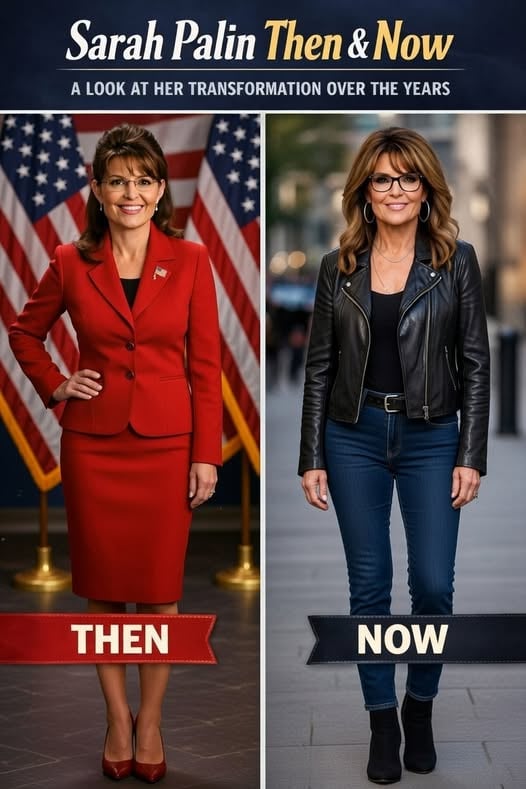
Her Image Changed. The Country Did Too.
The first time America laid eyes on her, the country wasn’t ready. Sarah Palin stepped onto the national stage like a gust of Alaskan wind, carrying a presence both commanding and approachable, wrapped in rimless glasses and a tight, carefully measured smile. There was a toughness in her posture, an unmistakable grit born from the long winters and small-town realities of Alaska, and it hit viewers like a cultural earthquake. Overnight, she became impossible to ignore—loved by some, mocked by others, endlessly analyzed by journalists, pundits, late-night comedians, and casual citizens alike. Her glasses, the precise tilt of her head, the cadence of her speech—all were scrutinized as though they contained the secret code to understanding a changing America. Even the smallest gesture could be interpreted as a political statement or a cultural signal, and people watched, dissected, and debated, trying to decode her persona as if it were a national barometer.
Over the years, as Sarah Palin’s public image shifted and her role transformed from Alaskan governor to national political figure to pop-cultural icon, one question grew louder and more insistent: who was changing more—the woman herself, or the country watching her every move with equal parts fascination and fear? Her evolution tells a story that stretches far beyond fashion choices, media optics, or campaign strategy. It is a narrative about identity, performance, and the ever-shifting mirror that is public perception.
From the beginning, Palin’s image was meticulously structured. In her early days on the political stage, she favored sharply cut jackets, precise updos, and understated eyewear. Every element of her appearance signaled discipline, competence, and a certain small-town authenticity that appealed to voters hungry for relatability in an era of career politicians. Her wardrobe, her hairstyle, and even the tone of her voice were carefully calibrated to communicate strength without alienation, ambition without arrogance. And yet, even at this stage, the media’s gaze was unrelenting, analyzing each photo, each televised exchange, each campaign speech as if it were a diagnostic chart of the American psyche. The stakes were high not only because of what she represented politically, but because she became a canvas upon which Americans projected their own anxieties, aspirations, and cultural conflicts.
As her platform expanded, so too did the expectations imposed upon her. Palin adapted, learning how to use her image strategically in a way that was both intuitive and performative. Jackets became sharper, colors brighter; the updos softened, then evolved into styles that conveyed both professionalism and approachability. She mastered the camera’s gaze, recognizing that being a public figure in the 21st century meant performing a version of oneself that could survive the unblinking lens of both traditional and social media. This evolution was far from superficial. It was a reflection of a woman negotiating in real time the complex interplay between personal identity and public perception, a constant balancing act between authenticity and spectacle, substance and style.